1.
Meganucleases
2.
ZFNs
3.
TALENs
4.
CRISPRs
Meganucleases
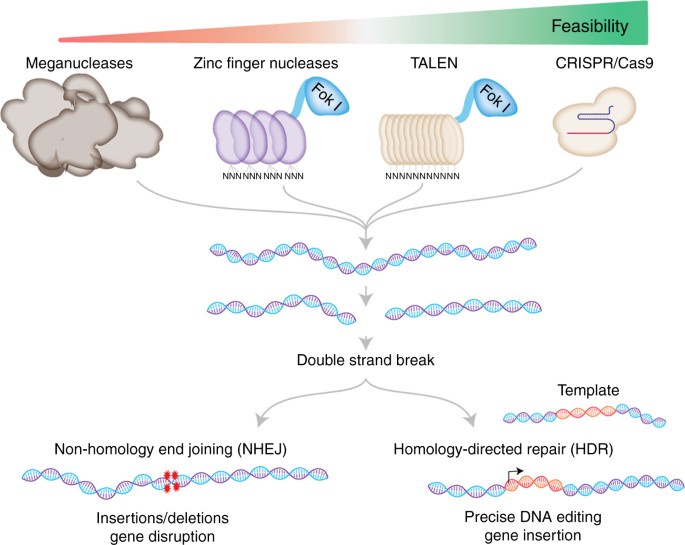
Meganucleases, are discovered in the late 1980s. It comes under Endonuclease family.
It can recognize and cut large DNA sequences (from 14 to 40 base pairs). I- Scal in yeast, I- CreI in clamidomonas are two of the examples of
naturally occurring meganucleases. Synthetic meganuclease prepared by rational design. They repair
double-stranded breaks (DSBs) via non homologous end joining (NHEJ) method.
Zinc finger nuclease (ZFN)
It is the 1st identified in a study of transcription in
the African clawed frog, Xenopus laevis in the laboratory
of Aaron Klug. These are hybrid restriction enzymes consist of 2 parts: generated by fusing a zinc finger DNA binding domain
to a DNA cleavage domain (Fok1). It is stabilized with Zn ion. It is an important tool for genetic
manipulation. ZFNs offer a rapid single-step approach to targeted gene knockout
in mammalian cells, using NHEJ.
TALENS
Transcription activator-like effector nucleases (TALENs) It
is specific DNA-binding proteins. It consists of an array of 33 or 34-amino
acid repeats. TALENs are artificial restriction enzymes designed by fusing; DNA binding domain (TALE) and a DNA cutting domain
(Nuclease-FOK1). This can be tailored to specifically recognize a unique
DNA sequence. These are forms "DNA scissors" for gene editing
applications to perform targeted genome modifications such as sequence
insertion, deletion, repair and replacement in living cells.
CRISPR Cas
The CRISPR- Cas system is a naturally occurring, adaptive immunity
against phages. (in Streptococcus pyogenes). It contains a cluster of
CRISPR-associated (Cas) genes and its corresponding CRISPR array. CRISPR
(Clustered Regularly Interspersed Short Palindromic Repeats) arrays consist
of repetitive sequences (direct repeats) interspaced by short stretches of
nonrepetitive sequences (spacers) derived from short segments of foreign
genetic material. It consist of:
- crRNA - Contains the guide RNA that locates the correct section of host DNA along with a region that binds to tracrRNA forming an active complex.
- tracrRNA - Trans Activating crspr RNA (tracer RNA). It is complimentary to CRSPR repeats that binds to crRNA and forms an active complex.
- sgRNA - single guide RNAs are combination of a tracrRNA and at least one crRNA
- Cas9 - protein whose active form is able to modify DNA. Many variants exits with different functions due to Cas9’s DNA site recognition function
- PAM (Protospacer adjacent motif) – it is the 2-6 base pair DNA sequence immediately following the DNA sequence targeted by the Cas9 nuclease in the CRISPR bacterial adaptive immune system. PAM is a component of the invading virus or plasmid, but is not a component of the bacterial CRISPR locus.
Comments
Post a Comment